A UK funding supervisor with over £286 billion ($377B) in property beneath administration is testing a sharper model of fund tokenization with BAGEY: public blockchains are getting used as a part of the report that claims who owns a regulated UK fund.
That lastly strikes the tokenization debate into fund administration quite than distribution alone. A tokenized fund can nonetheless be a blockchain-shaped declare on a standard product whose decisive possession report sits elsewhere.
Baillie Gifford is presenting a stronger mannequin, one the place the on-chain report varieties a part of the authorized possession register itself.
In that model, the token turns into the means by which an investor’s holdings are recorded. The consequence is tangible: if regulated fund possession can dwell natively on public chains, the change is within the fund administration stack, not in crypto market publicity.
Baillie Gifford’s digital property materials frames tokenization as an improve to possession data, settlement, entry, and consumer outcomes. The enchantment is that data and processes can transfer in a different way when possession is represented on shared rails.
The launch solutions one slender, tokenized-fund query with a professional sure: regulated funds are transferring towards authorized infrastructure on public chains, quite than blockchain-wrapped variations of present merchandise.
The mannequin nonetheless has to show it will possibly help secondary transfers, around-the-clock settlement, or collateral use exterior a managed primary-market setting.
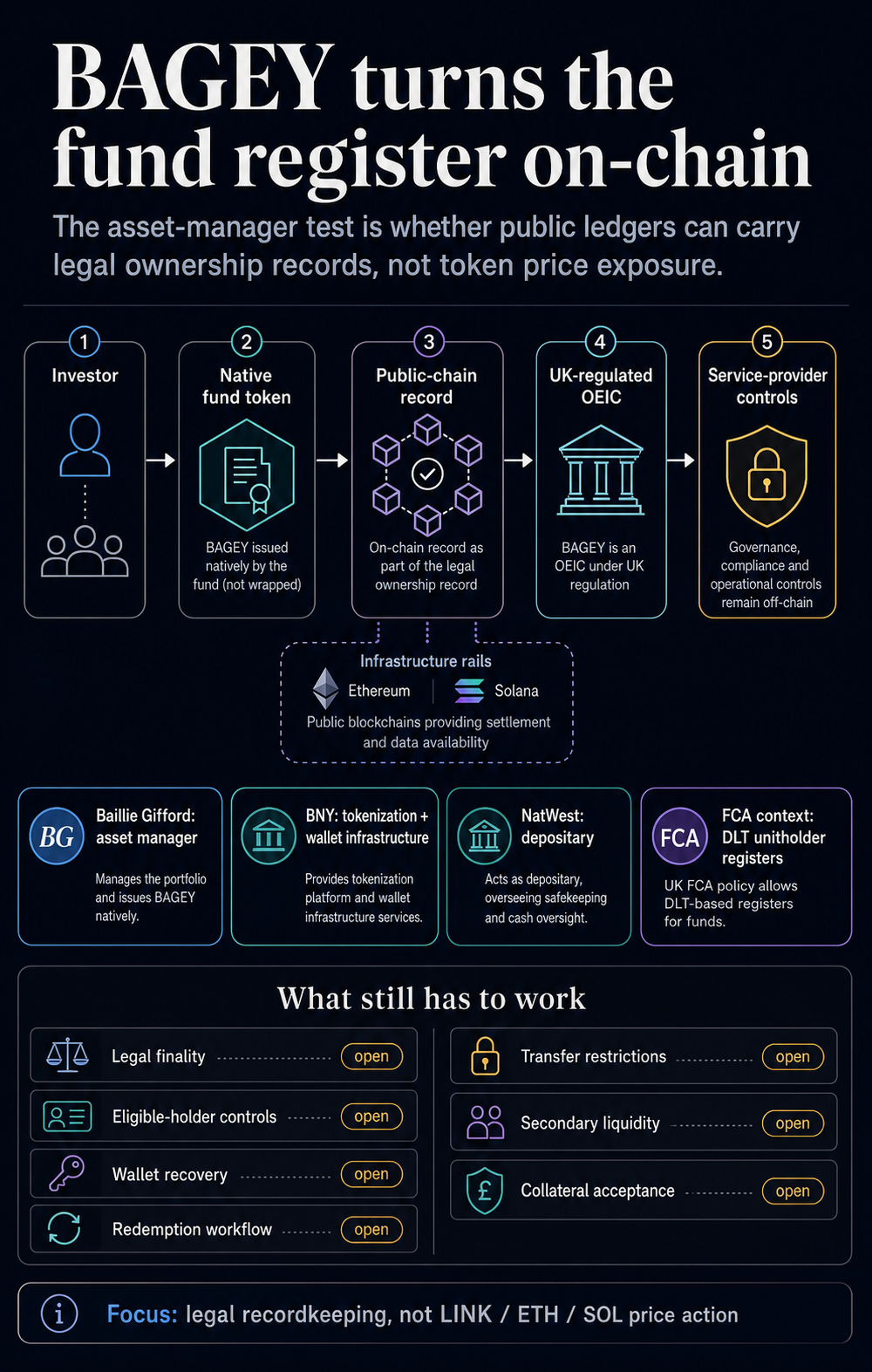
Native issuance shifts the possession report by way of tokenization
The central declare round BAGEY is native issuance. Baillie Gifford described it as a completely native UK-regulated tokenized fund working by way of a UK-regulated OEIC construction, with issuance on Ethereum and Solana, BNY offering tokenization and pockets infrastructure, and NatWest Trustee and Depositary Companies appearing as depositary.
If the blockchain is the authorized register, then the fund administrator, custodian, switch agent, depositary, and investor are coordinating round greater than a non-public database that later reconciles with a token.
The shared ledger turns into a part of the report that claims who owns what.
That’s materially totally different from a tokenized wrapper. A wrapper can provide buyers blockchain-based entry to fund publicity whereas preserving the legally decisive register inside conventional infrastructure.
It could actually nonetheless be helpful, however the operational middle of gravity stays off-chain. BAGEY’s extra vital declare is that the report layer itself has moved.
| Mannequin | The place possession lives | What the token does | Predominant query |
|---|---|---|---|
| Native tokenized fund | The on-chain report is introduced as a part of the fund possession register | Information the investor’s direct holding within the regulated fund | Can authorized, custody, switch, and restoration controls maintain up in manufacturing? |
| Tokenized wrapper | A separate fund or administrator report stays the decisive supply | Represents entry to an off-chain product | Does the wrapper add actual utility past distribution? |
| Crypto publicity product | Conventional product data stay central | Offers publicity to a token, chain, or associated technique | How does the asset worth carry out? |
That distinction retains LINK, ETH, and SOL worth motion secondary. Chainlink amplified the launch, and Ethereum and Solana present the public-chain infrastructure, however the information facilities on whether or not fund possession may be recorded natively on shared public ledgers inside a regulated construction.
The UK backdrop turns tokenization into fund plumbing
The UK backdrop is central. The Monetary Conduct Authority printed PS26/7 on fund tokenization on April 30, setting out how licensed fund managers can use distributed ledger know-how throughout the present licensed fund framework.
The coverage assertion covers tokenized fund fashions and DLT-based unitholder registers, offering BAGEY with a regulatory framework past an remoted product launch.
CryptoSlate beforehand coated the UK’s transfer to approve tokenizing FCA-authorized funding funds. That earlier shift issues as a result of BAGEY now backs the coverage course with a selected asset supervisor, fund construction, service-provider stack, and public-chain implementation.

It additionally follows tokenized-fund experiments through which Chainlink, Swift, UBS, and others examined subscriptions and redemptions, in addition to transfer-agent automation. These pilots demonstrated that conventional fund workflows could possibly be built-in with blockchain techniques.

BAGEY pushes the query additional. The related problem is whether or not the report of regulated fund possession can reside natively on public-chain infrastructure, quite than whether or not a single workflow may be automated.
For asset managers, that shifts the burden of proof. A tokenized fund wrapper may be evaluated primarily based on entry, distribution, and investor demand.
A local fund report should be assessed for authorized finality, operational resilience, controls over eligible holders, failed or mistaken transfers, pockets loss, sanctions screening, redemption timing, and the purpose at which a blockchain entry turns into enforceable in opposition to the fund.

These are sensible back-office particulars. They decide whether or not the token can ever turn into helpful past issuance and redemption.
A fund token that may be trusted because the authorized possession report may, in concept, transfer extra simply between permitted holders and settle exterior typical market hours as a result of counterparties can see and depend on the possession report. If these authorized and operational controls stay restricted, tokenization stays nearer to a managed distribution channel.
The identical warning applies to collateral. Baillie Gifford’s broader tokenization supplies focus on asset mobility and consumer outcomes, however BAGEY’s launch report alone doesn’t set up that the fund token is already accepted as collateral throughout market venues.
That’s the reason the following disclosures matter as a lot because the launch label: they’ll present whether or not the on-chain register modifications every day fund operations or primarily modifications how the product is issued.
The subsequent take a look at is operational proof
BAGEY reveals that a big conventional asset supervisor is prepared to place a regulated fund construction on public-chain rails and describes the consequence as native quite than wrapped. It additionally reveals that main service suppliers may be introduced into that construction.
BNY’s infrastructure position and NatWest’s depositary position matter as a result of regulated funds don’t turn into authorized infrastructure solely by way of a wise contract. They want oversight, reconciliation, controls, custody procedures, and investor protections that establishments can defend.
The launch stops wanting exhibiting that tokenized fund models will commerce freely across the clock, turn into broadly accepted as collateral, or change the remainder of the fund administration stack. These outcomes require proof of precise switch mechanics, secondary liquidity, investor onboarding, redemption efficiency, and authorized remedy beneath stress.
That’s the subsequent take a look at for tokenized funds. The trade already is aware of that monetary merchandise may be represented on blockchains.
The tougher query is whether or not regulated establishments will deal with public-chain data because the place the place authorized possession is established, up to date, and relied upon by different market members.
If the reply turns into sure, tokenization stops being largely a packaging story. It turns into a change to the plumbing behind fund possession.
Asset managers would then compete not simply on product publicity, however on how briskly, clear, transportable, and operationally dependable their fund data are.
If the reply stays partial, BAGEY should still be vital, however in a extra restricted approach. It might present that native issuance can work inside a managed surroundings whereas leaving probably the most consequential market features, together with peer-to-peer switch and collateral use, for later.
For now, BAGEY strikes the dialogue ahead with out ending it. It’s a dwell take a look at of whether or not public blockchains can carry a regulated possession report, quite than proof that they’ve already changed the previous fund administration stack.