Collector Crypt is popping crypto’s RWA debate right into a shopper stress check: randomized card packs, USDC sellbacks, bodily redemption, and CARDS incentives are producing exercise outdoors the tokenized Treasury mannequin crypto normally makes use of to promote RWAs.
The CARDS ticker moved via crypto circles on X after Arthur Hayes amplified it on June 23. That social warmth explains consideration; worth, sustainability, and sturdy collector demand nonetheless relaxation on working conduct.
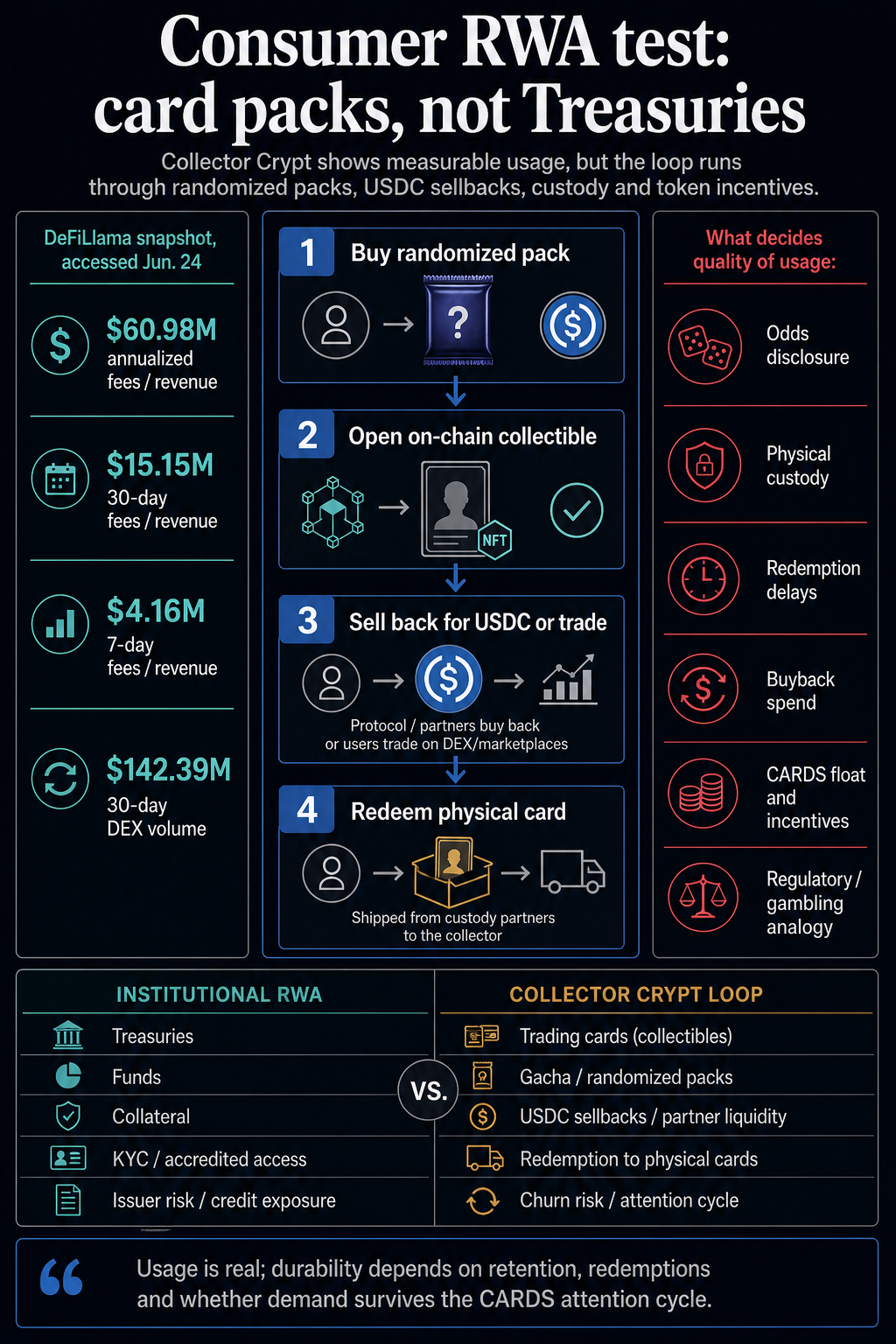
The working information is tougher to disregard. On June 24, DeFiLlama’s Collector Crypt dashboard confirmed $60.98 million in annualized charges and income; $15.15 million over 30 days; $4.16 million over 7 days; and $142.39 million in 30-day DEX quantity.
DeFiLlama additionally breaks down pack gross sales, market transactions, and pack buybacks, making the exercise simpler to examine than in most shopper crypto apps.
These figures give Collector Crypt an actual utilization case. In addition they demand a unique type of scrutiny.
DeFiLlama’s basic definitions deal with charges as user-paid protocol charges and income because the protocol-retained subset, whereas Collector Crypt’s protocol web page additional defines its personal payment and income metrics round pack gross sales, market exercise, and pack-buyback changes. Dashboard income stays an unaudited working sign.
Can a consumer-RWA app preserve customers paying for actual belongings as soon as the motivation and a spotlight cycle has cooled?
Card packs develop into the RWA interface
Collector Crypt’s official website describes the platform as a bridge to real-world collectibles, permitting customers to digitize their collections and commerce them.
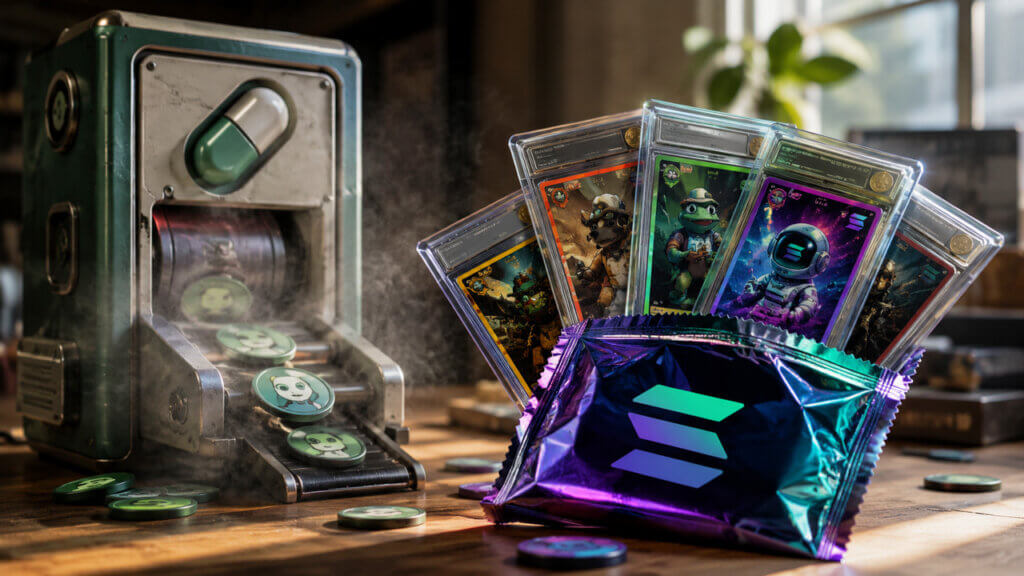
Its docs make the loop extra concrete: customers can buy thriller packs, open randomized NFTs, see dwell machine data, and use buyback endpoints tied to USDC.
The identical documentation additionally explains why the product sits in a extra sophisticated nook of RWA than tokenized Treasuries.
Collector Crypt’s gacha API helps pack buy, random NFT opening, and sellback mechanics. Its VRF documentation helps verifiable randomness and live-weight claims.
Its delivery API describes a redemption path for bodily supply of underlying playing cards via a submit, pay, and burn move.
That’s real-world asset infrastructure, however the person conduct is nearer to a collectible arcade than to an institutional collateral market. The asset is a card. The motion is opening a pack.
The liquidity path can embody a direct USDC sellback or secondary buying and selling. The danger spans odds disclosure, card valuation, custody, redemption, incentives, and the token inside the ecosystem.
| Mannequin | Principal asset | Person motion | Liquidity path | Danger focus |
|---|---|---|---|---|
| Institutional RWA | Treasuries, money-market funds, credit score | Allocate capital or use collateral | Redemption, settlement and DeFi integration | KYC, custody, yield, issuer and regulatory construction |
| Collector Crypt loop | Bodily buying and selling playing cards represented on-chain | Purchase or open randomized packs, commerce or redeem playing cards | USDC sellbacks, market exercise and bodily redemption | Odds, buybacks, card custody, redemption, token incentives and participant churn |
CryptoSlate has already lined how Collector Crypt’s card-pack week modified Solana‘s shopper income dialog. The category-level query now’s how a lot of that exercise survives after consideration shifts.
If shopper RWA utilization is arriving via gacha mechanics, the sector’s most energetic retail loop could carry a threat profile that institutional RWA consumers not often face.
The most effective case for Collector Crypt is easy: shopper RWA usually sounds summary till customers pay to work together with actual belongings.
Collector Crypt provides customers a concrete object, a game-like opening expertise, secondary-market liquidity, and a potential bodily redemption path. DeFiLlama’s payment and quantity information present that the loop has generated measurable on-chain exercise.
That makes it completely different from a lot of the broader RWA sector. CryptoSlate’s prior RWA protection has framed tokenization progress round Treasuries, money-market funds, credit score, and belongings that always sit outdoors lively DeFi utilization.

Collector Crypt is smaller than the institutional market, but it’s extra visibly consumer-facing.
The weaker case is simply as direct. A pack-opening financial system can look wholesome at the same time as consideration, buybacks, and rewards rise collectively.
The dashboard can present exercise whereas leaving unresolved how a lot demand comes from collectors who need the underlying playing cards, how a lot comes from merchants rotating via the loop, and the way a lot comes from customers chasing incentives or social proof.
Float and custody determine the standard of utilization
That distinction is central to the CARDS debate. As of press time, CryptoSlate’s coin web page reveals a CARDS value of round $0.27 per token, up 66% during the last month however down 13% within the final week. It has a market cap of roughly $111 million, a 24-hour buying and selling quantity of roughly $22.8 million, a circulating provide of roughly 416 million, and a complete provide of two billion.
That unfold turns float, unlocks, and market cap into threat variables as a substitute of a steady valuation base. If customers are shopping for packs for playing cards and redemption, CARDS is one a part of the ecosystem.
If consideration shifts towards the token and rewards, the loop can develop into extra reflexive.
The bodily card is what retains Collector Crypt contained in the RWA dialog. Additionally it is the place the toughest shopper questions sit. A person can personal an on-chain illustration, commerce it, or search bodily supply via the documented redemption move.
The dashboard leaves the toughest off-chain questions unanswered: who holds the cardboard, how grading or insurance coverage disputes are dealt with, how redemption delays are resolved, and the way a lot worth truly leaves the platform as card possession as a substitute of being recycled into extra pack openings.
A June 11 Solflare and Collector Crypt launch about Solflare Packs underscores the chance break up.
It describes randomized packs, odds proven earlier than buy, 18+ gating, and language classifying the packs outdoors monetary merchandise and funding choices. It additionally separates Solflare from accountability for sourcing, success, grading, storage, and redemption.
These disclaimers are helpful as a result of they are saying the quiet half out loud about shopper RWA. The expertise might be on-chain, however the belief chain reaches into warehouses, delivery processes, grading requirements, companion interfaces, and purchaser conduct.
The regulatory analogy additionally differs from tokenized Treasuries. The New York Legal professional Basic’s February motion in opposition to Valve targeted on paid randomized rewards with financial worth and cash-out paths in a gaming context.
For Collector Crypt, that type of enforcement consideration is a threat sign for paid randomization with resale worth. The present supply set helps that time as an analogy for platform design, separate from any regulator accusation in opposition to the mission or its companions.
Retention is the sign to observe
Collector Crypt has already cleared one hurdle that many shopper crypto apps not often attain: seen exercise that may be tracked outdoors the mission’s personal advertising.
DeFiLlama’s protocol web page, the official gacha and redemption docs, the CARDS market feed, and the social exercise round pack companions all level to an actual product loop.
The unresolved query is the standard of that loop. Sturdy shopper RWA would present customers returning for playing cards, retaining or redeeming bodily belongings, buying and selling as a result of the collectibles have unbiased demand, and accepting clear odds with much less reliance on fixed rewards.
Reflexive gacha churn would look completely different: quantity clustering round incentives, buybacks, social streaks, token unlocks, and a spotlight spikes.
The most effective reply at this time sits between these outcomes. Collector Crypt is proof that shopper RWA can generate actual utilization dashboards, whereas the mechanism that produced these dashboards seems to be extra like randomized collectibles and fewer just like the institutional RWA mannequin crypto normally sells to buyers.
That makes the following information factors extra necessary than Hayes’ submit or any single CARDS value transfer.
Watch repeat customers, redemption charges, card retention, buyback spend, official affirmation of CARDS buyback mechanics, partner-pack enlargement, and CARDS conduct after the present consideration cycle. These alerts will present, with higher analytics, whether or not Collector Crypt is constructing a consumer-ownership market or a gacha flywheel.