Tether’s deserted Bitcoin mining enterprise in Uruguay, the place a former contractor estimated spending reached about $120 million throughout two websites, is casting a shadow over the stablecoin issuer’s smaller renewable-energy pilot in Brazil.
The Uruguay mission unraveled after Tether’s native entity, Microfin, and state utility UTE disagreed over the phrases governing electrical energy use, Reuters reported. Microfin understood its contracted allocation at the least that might be expanded, whereas UTE handled it as a most.
The dispute was underway by late 2024. Microfin stopped paying energy payments in Could 2025, notified UTE the next month that it deliberate to terminate the contracts, and later failed to finish revised phrases. UTE disconnected the websites on July 25.
By November, Tether, the USDT issuer, had notified labor authorities that it will stop operations and lay off most employees. Microfin settled the excellent UTE debt in December.
A former contractor estimated Tether spent roughly $60 million at every of the 2 websites in Uruguay’s Florida division. The roughly $120 million determine is an estimate of spending, not a confirmed loss disclosed by Tether.
The collapse contrasts with Tether’s 2023 launch of the enterprise, when the corporate cited Uruguay’s renewable technology and grid reliability as benefits for Bitcoin mining.
The expertise is straight related to Tether’s subsequent South American mission, which is tied to Adecoagro, a number one producer of sustainable agricultural items and power in South America.
Adecoagro representatives visited Tether’s Uruguay mining facility in February 2025 whereas the agricultural producer and Tether explored utilizing renewable energy for cryptocurrency mining. 5 months later, the businesses introduced a memorandum of understanding for a 230 MW pilot in Brazil.
In the meantime, that mission is materially smaller. Adecoagro stated the pilot would use about 10 megawatts of surplus renewable power that may in any other case be offered into the spot market.
The greater than 230 MW cited within the corporations’ announcement refers to Adecoagro’s broader renewable technology capability throughout South America, not energy dedicated to Bitcoin mining.
The disclosures don’t present that Tether redesigned the Brazil mission due to what occurred in Uruguay, nor do they set up that the brand new enterprise faces comparable issues.
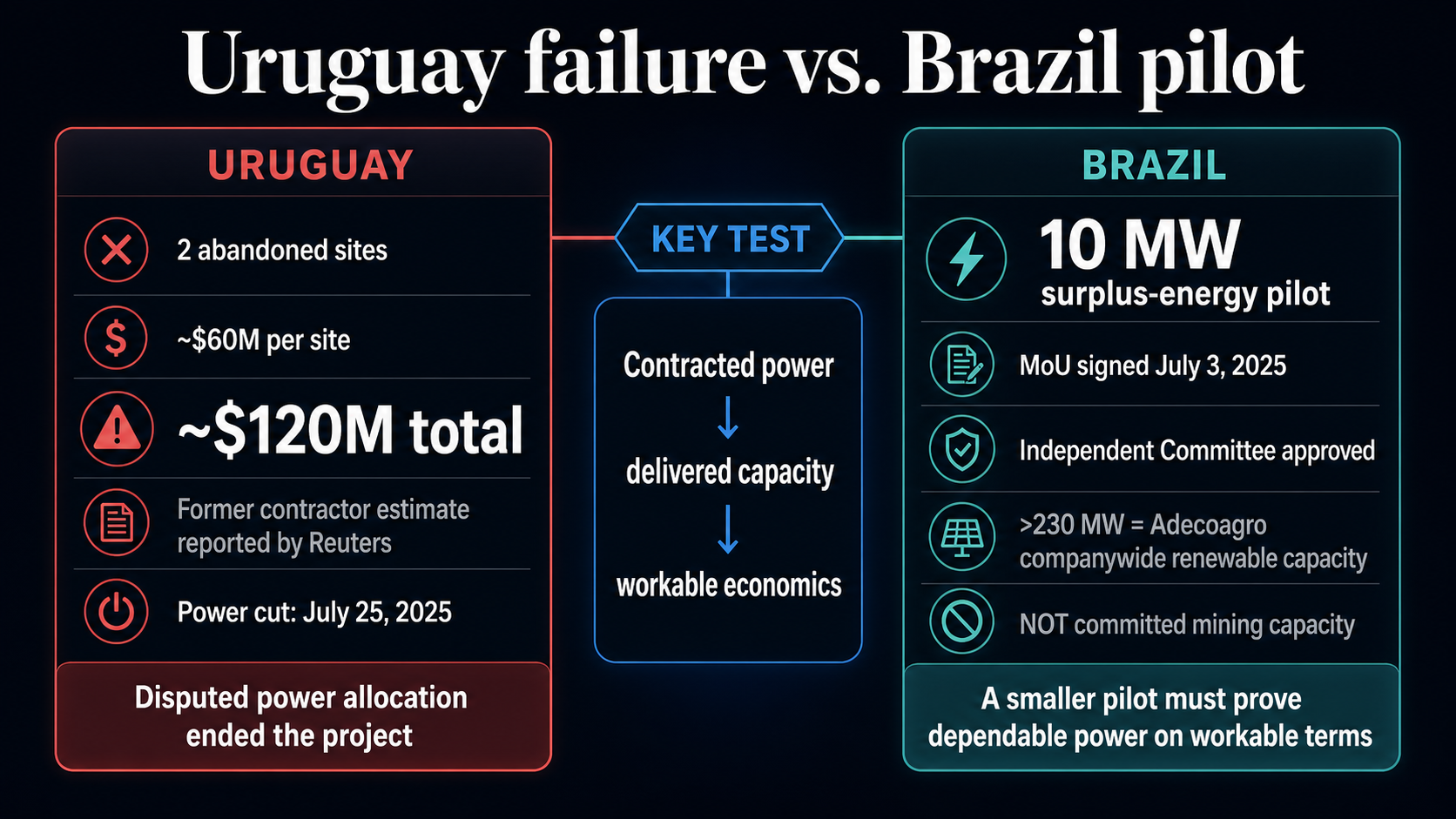
Nevertheless, they make Brazil the subsequent take a look at of Tether’s regional mining technique after Uruguay confirmed that renewable-energy availability alone doesn’t assure a workable mining operation. Clear energy phrases, reliable capability and sustainable economics proved simply as vital.