MoneyGram launched MGUSD, a US greenback stablecoin on Stellar, because the remittance firm deepens its push into blockchain-based cross-border funds.
The corporate stated Tuesday that MGUSD can be built-in into the MoneyGram app by means of a self-custodial pockets, permitting customers to carry dollar-denominated balances, transfer funds globally and convert into native currencies. The stablecoin initially launched within the US market, with plans to scale worldwide.
MGUSD is backed by a notable infrastructure stack. The tokens are issued by Bridge, Stripe’s stablecoin platform, which acquired conditional approval from the US Workplace of the Comptroller of the Forex to function as a federally chartered nationwide belief financial institution in February.
MGUSD is issued by Bridge, Stripe’s stablecoin platform, with mint-and-burn good contract infrastructure from M0 and pockets infrastructure from Fireblocks.
The launch marks a deeper step within the remittance business’s stablecoin push, shifting from backend settlement and payout partnerships towards app-based digital-dollar balances for customers.
MoneyGram stated MGUSD builds on its long-running partnership with the Stellar Improvement Basis. The corporate described the stablecoin as a deeper transfer into issuance, steadiness infrastructure and broader community utility.
Remittance prices drive onchain push
The launch comes as remittance corporations more and more take a look at blockchain infrastructure for cross-border funds, a sector that continues to be pricey and inefficient in contrast with home techniques.
International price of sending $200 in remittances. Supply: World Financial institution
In a 2026 paper, the Financial institution for Worldwide Settlements (BIS) stated cross-border funds stay “extra pricey, much less accessible, slower, and fewer clear” than home funds, regardless of new cost preparations. Retail cross-border funds may also take a number of days, whereas transparency could be restricted.
Associated: Western Union groups with Crossmint to assist USDPT stablecoin on Solana
World Financial institution information confirmed that sending $200 throughout borders price a mean of 6.36% within the third quarter of 2025, that means charges and foreign-exchange margins consumed about $12.72 of a $200 switch. That continues to be greater than double the United Nations Sustainable Improvement Objective goal of three%.
Stablecoin transfers can cut back the blockchain settlement part of a cost to a fraction of a cent, although customers should pay on-ramps, off-ramps, international trade spreads and native payout charges. Stellar’s developer documentation says the community minimal price is 100 stroops, or 0.00001 XLM (about $0.000002) per operation.
Stablecoins have additionally grown into a big sufficient market to attract consideration from cost corporations. DefiLlama information exhibits that the entire stablecoin market cap is at round $320 billion, whereas Citi forecast in September 2025 that stablecoin issuance may attain a base case of $1.9 trillion by 2030.
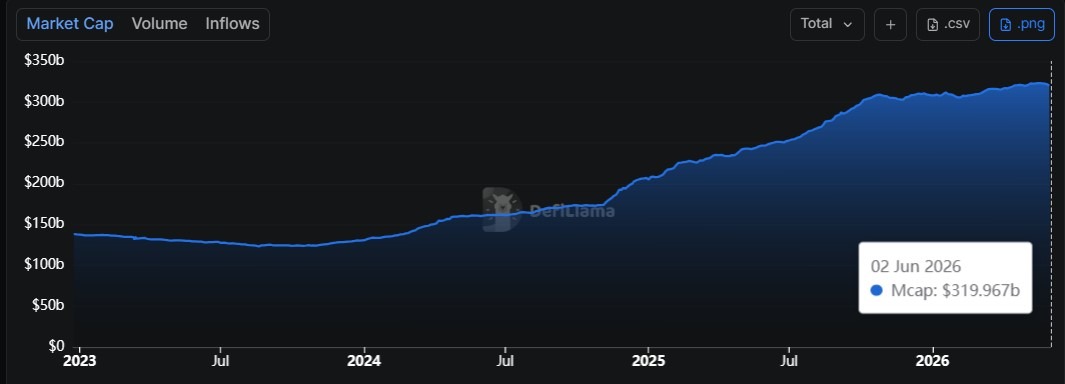
Stablecoin market cap. Supply: DefiLlama
That price hole and stablecoin progress assist clarify why remittance corporations are testing stablecoin infrastructure. On Could 5, MoneyGram partnered with crypto trade Kraken to permit customers to transform crypto into money for pickup throughout 100 nations. On Could 20, the corporate partnered with the Stripe-incubated blockchain Tempo to assist stablecoin settlement and assist validate remittance transactions.
Its enterprise rival, Western Union, has additionally moved into stablecoins. On Could 5, the corporate started rolling out its USD stablecoin referred to as USDPT on Solana, initially in Bolivia and the Philippines, with plans to broaden to over 40 nations in 2026.
Journal: 50K traders combat Korean crypto tax, Singapore cancels Bsquared: Asia Categorical