Traders appeared to ignore Hut 8’s reported first quarter 2026 internet lack of greater than $253 million on Wednesday, lifting the shares of the Bitcoin mining firm by greater than 33%.
Hut 8 attributed the loss to a discount out there worth of its Bitcoin (BTC) holdings, which fell from a excessive of over $126,000 apiece in October to a low of $60,000 in February.
Income for quarter totaled greater than $71 million, down by about 22% from the earlier interval’s $88.4 million, in line with Hut 8’s earnings statements. Analysts had forecast $78.5 million, in line with FactSet.
The corporate additionally introduced a $9.8 billion deal that may see Hut 8 lease 352 megawatts to a third-party AI firm over a 15-year interval. Wednesday’s outcomes confirmed the corporate generated $66.0 million in first quarter income from ASIC compute, AI cloud and conventional cloud options.
Hut 8’s inventory surged following information of a $9.8 billion deal. Supply: Yahoo Finance
The corporate’s diversification into AI and vitality infrastructure comes amid an industry-wide pivot away from crypto mining, as public crypto mining firms wrestle with excessive prices and declining revenues.
Associated: Bitcoin miner Core Scientific shifts to AI with 1.5GW knowledge middle push
AI and Bitcoin mining more and more compete for energy
The shift to AI threatens the Bitcoin mining {industry}, in line with crypto dealer and market analyst Ran Neuner.
“Each industries compete for a similar factor: electrical energy,” Neuner mentioned, including, “proper now, AI is keen to pay rather more for it.”
Mining firms could make anyplace between $57 and $129 per MW securing the blockchain, in comparison with between $200 and $500 per MW for AI infrastructure, he mentioned.
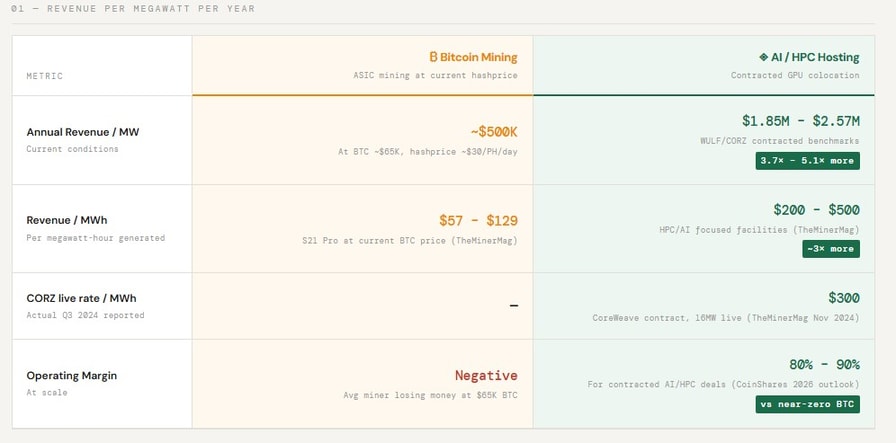
Income comparability for Bitcoin mining and AI internet hosting. Supply: Ran Neuner
As miners shift their focus to more-profitable AI ventures, the overall quantity of computing energy devoted to securing the Bitcoin blockchain declines, making the community simpler to assault, Neuner mentioned.
The necessity for enormous quantities of vitality to energy high-performance computing purposes, together with Bitcoin mining and AI workloads, has pushed demand for nuclear vitality technology.
Since 2024, a number of AI hyperscaling firms like Google, Microsoft, Amazon and Meta have introduced nuclear vitality offers to energy their AI infrastructure.
Journal: How AI simply dramatically sped up the quantum threat for Bitcoin