Banks are shifting onchain by means of competing fashions that take totally different approaches to how monetary guidelines are enforced.
On the one hand are blockchain-native builders like Matter Labs co-founder Alex Gluchowski, who argue that monetary techniques require guidelines to be enforced throughout all individuals. On the opposite are networks constructed for establishments like Canton, which prioritize privateness, management and interoperability over international state.
Gluchowski is among the many most vocal critics of the latter method, arguing it reproduces the restrictions of conventional finance in a brand new type. The core of the critique is whether or not guidelines will be enforced throughout a whole community. That’s not attainable in techniques like Canton, he claimed.
“However they’re attainable with blockchains — particularly with zero-knowledge techniques anchored to public blockchains like Ethereum, which is an surroundings all events can belief as a result of it can’t be captured by any single company curiosity,” Gluchowski instructed Cointelegraph.
Crypto’s institutional adoption is bringing banks and monetary establishments onchain, nevertheless it’s additionally splitting the trade alongside a deeper fault line than geography or regulation.
Canton rose into the highest 21 cryptocurrencies regardless of criticism from decentralization purists. Supply: CoinGecko
What counts as a blockchain?
Canton has gained traction by focusing on privateness and regulatory necessities, connecting banks and asset managers by means of a community the place transactions are shared solely with related counterparties somewhat than broadcast system-wide. The community contains institutional individuals equivalent to JPMorgan and Goldman Sachs.
Whether or not Canton counts as a blockchain is determined by how the time period is outlined and what properties it’s anticipated to ensure.
For Gluchowski, a blockchain’s core function is a single shared ledger that enables guidelines to be enforced throughout all individuals without delay. He claimed Canton doesn’t qualify. The community connects establishments by means of bilateral or trilateral relationships, the place every get together sees and verifies the transactions it’s straight concerned in.
“Earlier than blockchains, banks needed to enter bilateral relationships and outline how they deal with edge instances by means of contracts and API interactions,” Gluchowski mentioned. “It’s simply taking these current relationships and workflows and placing them right into a tokenized type.”
Gluchowski mentioned Canton’s mannequin limits what the system can assure. Whereas individuals can confirm the transactions they’re straight concerned in, they can’t independently confirm system-wide properties equivalent to complete asset provide or different guidelines that apply throughout all customers. He added that these sorts of ensures require a shared state that everybody can examine.
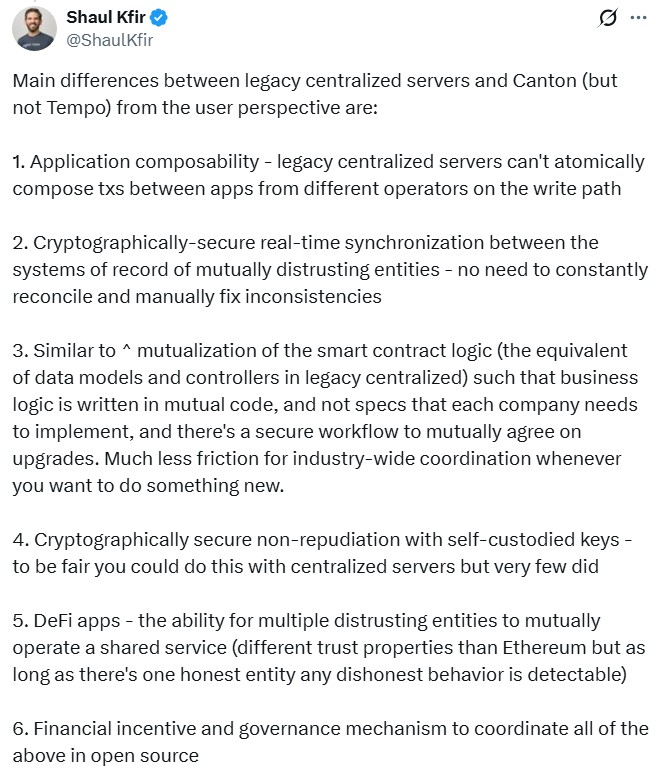
Digital Asset co-founder particulars how Canton differs from legacy techniques in observe. Supply: Shaul Kfir
Associated: Privateness instruments are rising behind institutional adoption, says ZKsync dev
“[Gluchowski] is right that Canton doesn’t have a worldwide shared state, however he’s incorrect in implying that this negatively impacts Canton’s belief mannequin,” Shaul Kfir, co-founder of Digital Asset, responded by means of an announcement shared with Cointelegraph.
“In Canton, as in all different blockchains, I solely belief my very own validator and assume anybody else will be malicious. This ‘don’t belief, confirm’ method could be very totally different from a distributed API system,” Kfir added.
In Canton’s mannequin, belief doesn’t come from a single system-wide view, however from every get together independently checking the transactions it’s concerned in.
Community guidelines conflict with issuer management
Following the dialog with Cointelegraph, Gluchowski took half in a dwell debate with one other Digital Asset co-founder, Yuval Rooz. He reiterated his argument that monetary guidelines have to be enforced throughout a whole community in a blockchain community.
Rooz countered that system-wide enforcement doesn’t get rid of reliance on trusted events, as public blockchain customers nonetheless depend upon token issuers. Rooz pointed to hacks that concerned property like USDC to argue that issuers stay the important thing enforcement mechanism.
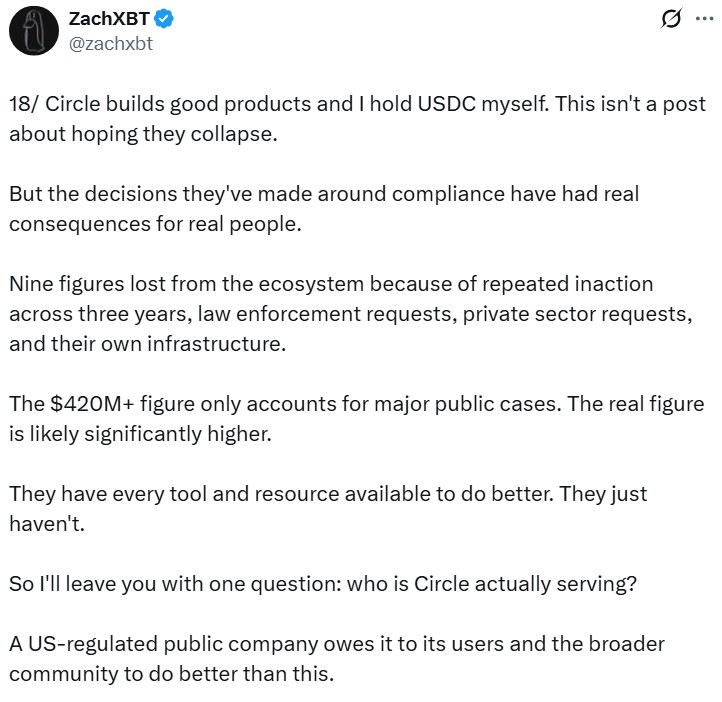
The trade has repeatedly known as for Circle to freeze stolen funds earlier than illicit actors commerce them for decentralized property. Supply: ZachXBT
Associated: Immediate settlement strains crypto’s capital effectivity: Ethan Buchman
“Really, we might have been happier — as we have seen plenty of the crypto house saying if the centralized issuer had been to intervene sooner somewhat than permitting these property being traded and swapped into permissionless property the place then they’ll now not intervene,” Rooz mentioned.
“On Canton, no totally different than some other public chain, the issuer is centralized in actual world property, they usually have totally different properties or related properties to what they’d have on public permissionless chains,” he added.
Gluchowski argued that issuance limits will be embedded straight into good contracts. He mentioned that on networks like Ethereum, exercise past a sure threshold will be restricted or require further approval, somewhat than relying solely on the issuer’s infrastructure.
“On Canton, you rely solely on the multisig. On Ethereum, you depend on good contracts which might be enforced by the community,” Gluchowski mentioned.
“It is simply completely not true,” Rooz replied.
Kfir, whose assertion was shared with Cointelegraph after the dwell debate, mentioned that Gluchowski is “complicated the capabilities of Canton” with how it’s utilized by centralized RWA issuers.
“When there’s a centralized RWA issuer, e.g. a stablecoin issuer, you’re already trusting them with the ‘mint’ operate, and also you’re trusting them and their auditors that the quantity onchain is backed by reserves off-chain,” Kfir mentioned.
Competing visions for bringing banks onchain
Canton and Matter Labs are competing to unravel the identical drawback of how institutional finance strikes onchain. Matter Labs, the developer of ZKsync, is focusing on institutional use instances with Prividium, a mannequin that retains transactions non-public whereas anchoring verification to Ethereum by means of zero-knowledge proofs.
Kfir argued that techniques like Prividium threat concentrating belief in a distinct place. In his view, customers are now not independently validating the related state, forcing them to reconcile their very own information towards what an operator experiences occurred onchain.
“ZKsync depends on Prividium operators who create ZKPs, however ZKsync’s personal open supply consumer doesn’t confirm these proofs,” he mentioned. “And even when a person does confirm, it doesn’t confirm which good contract logic is operating. The person is totally on the mercy of the Prividium operator.”
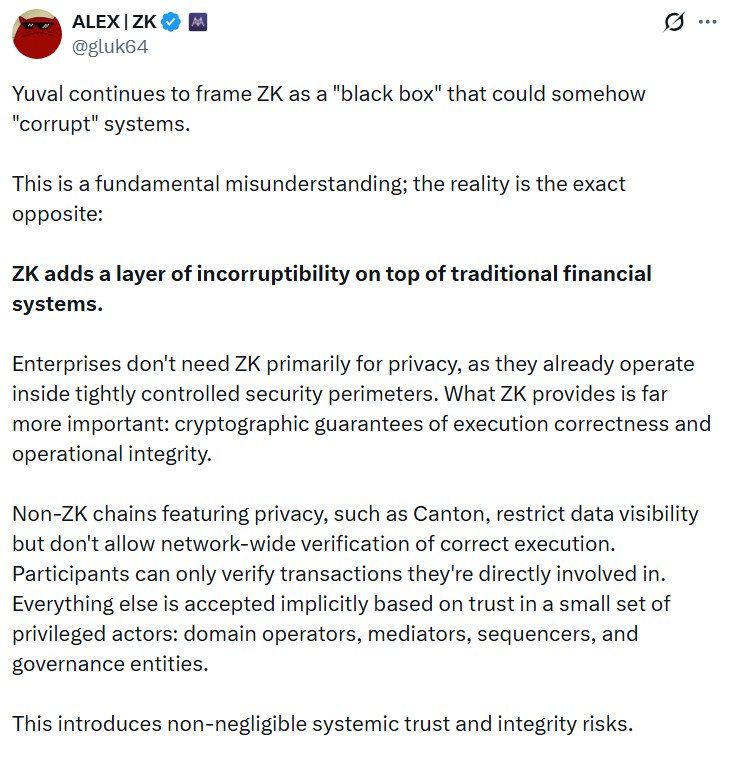
Gluchowski defended ZK expertise in a February social media change with Rooz. Supply: Alex Gluchowski
Rooz did concede one level throughout the debate, which is that Canton doesn’t have public verifiability, whereas including that there are plans to introduce it sooner or later.
For now, the divide stays unresolved. Canton is constructed round privateness and institutional management, whereas ZKsync’s Prividium makes an attempt to protect these options whereas anchoring verification to a public community. Each declare to supply a viable path for bringing banks onchain, however they’re constructed on basically totally different assumptions about how monetary techniques ought to work.
Journal: Adam Again says present demand is ‘virtually’ sufficient to ship Bitcoin to $1M