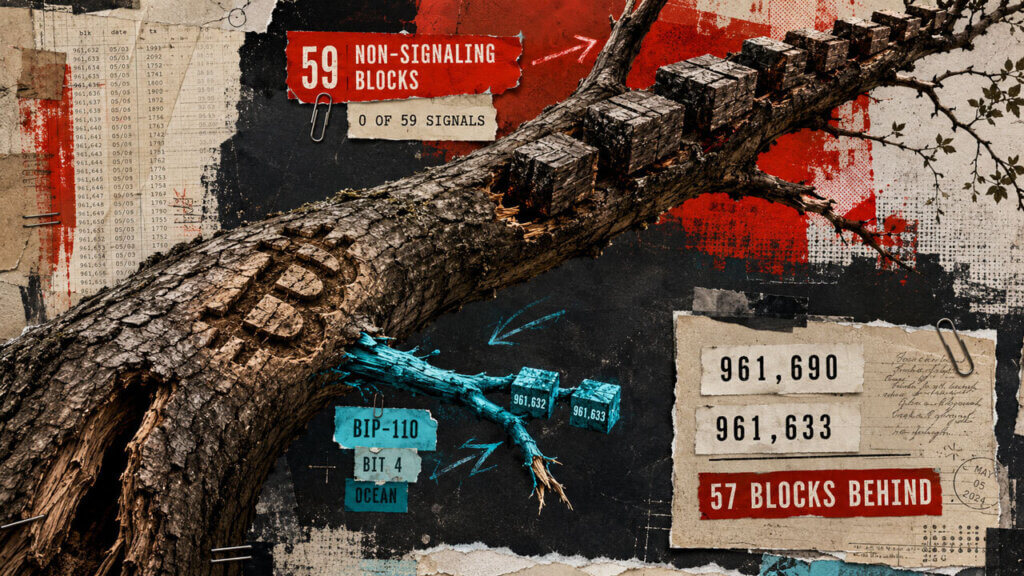
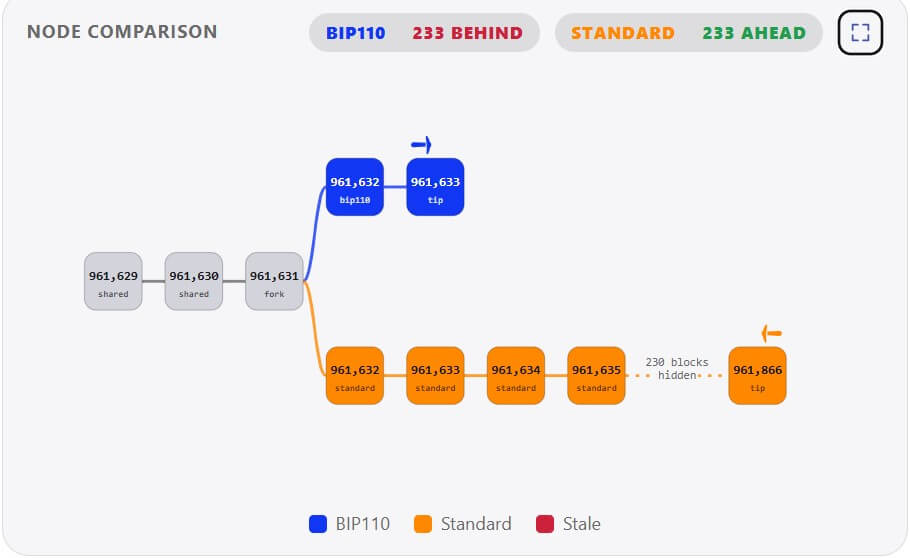
Bitcoin’s BIP-110 push failed to realize significant mining help over the weekend, leaving the proposal stranded on a minority chain that produced solely two blocks earlier than stalling at top 961,633.
The delicate fork was designed to briefly limit a number of types of arbitrary information on Bitcoin and required 55% miner signaling throughout its deployment window.
As an alternative, signaling peaked at just a few proportion factors earlier than obligatory signaling started at block 961,632, the place BIP-110 nodes rejected blocks they thought of invalid and break up from the dominant chain. Roughnecks mined the minority department’s first two blocks, however no third block adopted.
This end result had shifted the controversy from whether or not BIP-110 might activate to what ought to occur to it and to considered one of its most seen backers, Bitcoin developer Luke Dashjr.
BIP-110 collapse sparks backlash towards Dashjr
The weekend break up drew sharp criticism from Bitcoin figures who framed the end result as a rejection of BIP-110.
Technique Government Chairman Michael Saylor stated roughly 99.85% of Bitcoin’s hashpower remained on the dominant chain, leaving BIP-110 with about 0.15%. At that charge, he estimated the minority department might take about 25 years to mine the two,016 blocks wanted for its first problem adjustment.
“Consensus is earned, not declared,” Saylor stated, arguing that miners, exchanges, custodians, wallets, holders and different financial infrastructure had overwhelmingly remained with the dominant community.
David Bailey, the CEO of Bitcoin treasury firm Nakamoto, was extra dismissive, calling BIP-110 the least common and most inconsequential delicate fork ever tried and saying its backers ought to replicate on the failed activation.
In the meantime, the softfork fallout has rapidly moved past the fork itself.
BIP editor Mark “Murch” Erhardt on Sunday proposed eradicating Dashjr from the BIP editorial crew, accusing the veteran developer of utilizing his place inconsistently whereas advocating BIP-110.
Murch stated Dashjr tried to assign the proposal a quantity earlier than the standard mailing-list dialogue and later merged an replace inside minutes of a associated pull request being opened.
The proposal has since been changed into GitHub pull request 2248, which remained open Monday.
A number of Bitcoin builders backed the removing effort. Matt Corallo supported the movement, whereas fellow BIP editor Olaoluwa Osuntokun formally seconded it. Jonas Nick additionally supported eradicating Dashjr, saying BIP editors ought to apply the method neutrally.
Antoine Riard stated Dashjr ought to step apart, at the least briefly, however warned that the BIP course of doesn’t present a transparent process for forcibly eradicating an editor.
The dispute subsequently leaves builders debating Dashjr’s conduct and the way such a call ought to be made.
BIP-110 supporters restart mining and push PoW change
BIP-110 supporters are responding to the setback by difficult the premise that their department misplaced a official consensus combat.
Dathon Ohm, the proposal’s writer, accused giant mining swimming pools of colluding to show Bitcoin right into a “poisonous information dumping floor” by mining blocks rejected by BIP-110 nodes. He stated supporters had been engaged on a proof-of-work change supposed to “fireplace the miners.”
Dashjr backed that place, arguing that BIP-110 nonetheless has neighborhood help and that solely a small variety of dangerous actors had been attacking it. He stated:
“There’s only a tiny few dangerous actors attacking it. PoW change eliminates their menace.”
A proof-of-work change would characterize a much more disruptive escalation than BIP-110’s unique delicate fork. Bitcoin miners presently depend on specialised SHA-256 {hardware}, so an incompatible algorithm would create a separate mining setting and pressure supporters to construct their very own base of miners, wallets, exchanges, liquidity, and customers.
Roughnecks, the pseudonymous mining group that discovered each blocks on the BIP-110 department, now says it intends to maintain that chain alive whereas such a change is taken into account.
On Aug. 10, the group stated that it could resume mining from block 961,633 after initially suspending operations.
It claimed miners on the dominant chain had “forked themselves off the community” and described Bitcoin Knots-RDTS as Bitcoin’s reference consumer, a characterization rejected by opponents of BIP-110.
“We’ve determined to renew mining ASAP on the stalled chain tip,” Roughnecks stated, including that it could proceed till a “smart POW change” might substitute the mining swimming pools it blamed for abandoning the department.
The reversal comes lower than two days after Roughnecks stated mining beneath the present proof-of-work setup was largely wasteful and suggested different BIP-110 miners to pause.
Its determination means the minority department might start producing blocks once more, although it nonetheless carries Bitcoin’s present problem stage and has solely a fraction of the computing energy securing the dominant community.
Dashjr additionally rejected the push to take away him as a BIP editor. He known as Murch’s accusations false, stated he had adopted the BIP course of constantly for years, and countered that Murch ought to be eliminated as an alternative.
The outcome leaves BIP-110 in an uncommon place. Its weekend activation did not win over miners, and its department stalled after two blocks, but its supporters are actually attempting to revive that chain whereas laying the groundwork for a proof-of-work change that might flip a failed soft-fork marketing campaign right into a broader combat over who will get to outline Bitcoin’s guidelines.