Key Takeaways
- Charles Edwards says bitcoin treasuries are “levering up at file charges” on debt-fueled progress.
- He likens the 200 bitcoin treasuries available in the market right this moment to the leveraged funding trusts of 1929.
- The warning lands as Technique holds about 76% of company BTC and shopping for collapses elsewhere.
A Yr-Previous Warning Resurfaces
Bitcoin treasury firms are taking over debt at file charges to fund their bitcoin purchases, Capriole Investments founder Charles Edwards warned. He tied the pattern again to a name he made in October 2025, arguing that the digital asset treasury (DAT) mannequin is structurally incentivized to depend on borrowing to fabricate returns, additional including:
“ Bitcoin DATs are levering up at file charges. Again in Oct 2025 I warned precisely this may occur as this unsustainable enterprise mannequin is incentivised to depend on debt to generate faux ‘yield’.”
His core objection is to how the technique generates its headline returns. A digital asset treasury, or DAT, is a public firm that raises capital (typically by way of debt or share gross sales) to build up bitcoin on its stability sheet. The mannequin, pioneered by Technique Inc. (Nasdaq: MSTR), can amplify good points when bitcoin rises, nevertheless it additionally provides leverage in order that when costs fall, corporations that borrowed to purchase can face strain to boost money, service debt, or promote.
The 1929 Comparability and “Pretend Yield” Narrative
Earlier this 12 months, Edwards in contrast the fast buildout of DATs to the leveraged funding trusts of 1929, calling them a “ leverage explosion ready to occur.” He pointed to the roughly 200 bitcoin treasuries now in existence and argued that the extra they lever up, the extra a drawdown can cascade by way of pressured deleveraging, with every vendor pushing the worth decrease for the subsequent.
Furthermore, his “faux yield” cost cuts at how treasury corporations market themselves, on condition that many tout a bitcoin-per-share progress metric as a type of yield. Edwards contends the determine is essentially a product of issuing new debt and shares fairly than real revenue. In easier phrases, it may be considered as a flywheel that works solely whereas capital markets keep open and costs keep excessive.
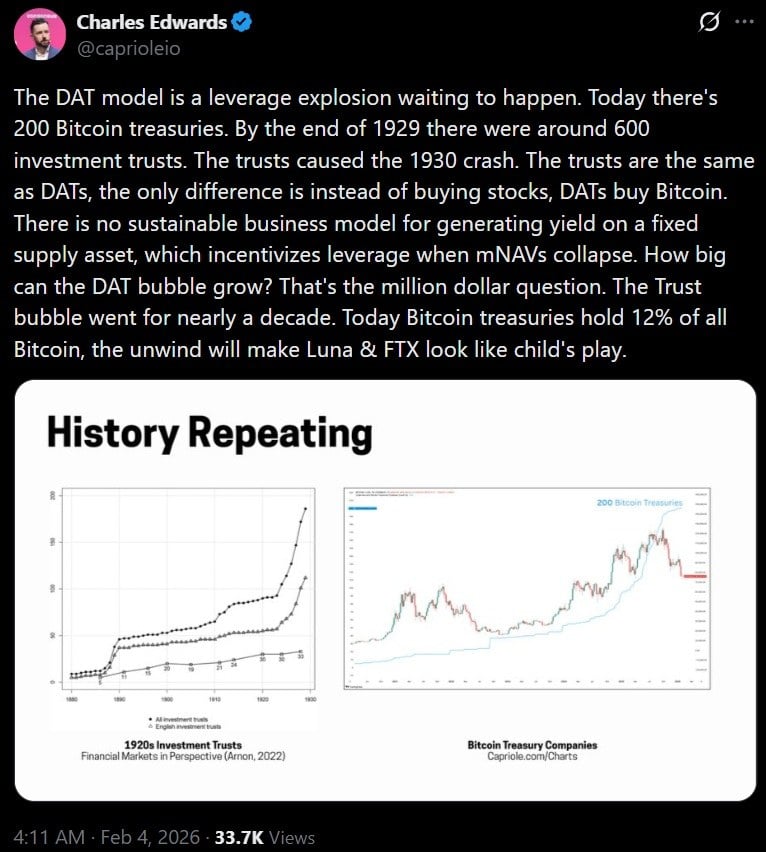
With so many public firms and exchange-traded funds (ETFs) now holding bitcoin, a synchronized unwind, in his view, may flip an atypical correction into one thing sharper.
The Pressure Is Already Displaying
The warning arrives because the treasury mannequin faces actual stress, with Bitcoin.com Information reporting earlier this month that bitcoin treasury firms are going through a borrow-or-sell check, with the query shifting from accumulation to liquidity (i.e. how corporations fund dividends, debt prices, and different commitments with out reducing BTC publicity).
That strain has reached the highest of the market as Cryptoquant information confirmed treasury shopping for exterior Technique has collapsed with non-Technique corporations shopping for a mixed 1,000 BTC over 30 days, a 99% drop from an August 2025 peak. Consequently, Technique now holds roughly 76% of all company bitcoin.
Others are leaning tougher into leverage. Japan’s Metaplanet, as an example, executed about 20 rounds of debt-for- BTC financing in roughly two years, together with zero-coupon bonds, because it chases a 100,000 BTC goal. Bitcoin.com Information reported the corporate posted a $725 million quarterly loss whilst its stack reached 40,177 BTC.
Why It Issues Now
Bitcoin just lately posted its worst week for the reason that 2022 FTX collapse, sliding under $60,000 as file exchange-traded fund (ETF) outflows hit the market. In a downturn, the monetary engineering that powered the treasury increase on the way in which up can work in reverse, pressuring probably the most indebted corporations first.
Trying forward, if BTC recovers, the leverage that worries Edwards may as soon as once more seem like savvy monetary engineering. If the downturn drags on, probably the most leveraged treasuries would be the first to really feel it.