Because the US proclaims extra investments in mining and processing, the general public and mining firms have to be extra conscious of how that’s shifting the federal government’s function within the sector, its financial system and management, a brand new GEM Consulting research reveals.
Governments are transferring past regulating critical-mineral tasks to change into lenders, buyers and clients, reshaping how mining firms finance tasks and who in the end holds affect over their output, the consultancy argues.
The shift implies that firms looking for public funding should compete on greater than geology, prices and traditional bankability. They more and more want to fulfill authorities necessities overlaying product origin and qualification, home or allied content material, workforce, reporting and safety of provide.
An August US critical-minerals bundle illustrates the size and number of that involvement. It included a conditional mortgage of about $1.4 billion for Sila, roughly $400 million for Dawn Vitality Metals and about $150 million for Niron Magnetics, alongside smaller commitments for Strategic Bauxite, Westwater Assets, International Superior Metals and Harena pilot work. Greater than $180 million was earmarked for mining training.
This practically $2 billion funding in mining reveals how federal help can’t be thought of the identical factor for all beneficiaries, as all of them could have completely different targets, functions and rights.
The research argues that all these differing types and portions of presidency funds could have completely different ends in the long run. A big mortgage, for instance, can decrease the price of capital for a mission transferring towards business scale, whereas a a lot smaller grant may show extra consequential if pilot testing or buyer qualification unlocks considerably extra non-public financing. Training funding doesn’t straight improve mine manufacturing however may ease workforce shortages affecting a number of tasks.
International fashions
The US isn’t alone. Canada, Australia, the European Union and Japan have developed their very own approaches to financing mining and critical-mineral provide chains, however GEM’s comparability reveals that no main system depends on a single funding instrument.
The US makes use of the broadest mixture of loans, fairness, grants, buy rights and stockpiles, whereas Canada places better emphasis on infrastructure and fairness participation. Australia combines financing with output rights and strategic inventories, the European Union emphasizes public credit score, grants and allowing coordination, and Japan focuses on financing, offtake and deployable stockpiles.
GEM emphasizes how essential it’s to make this data available to the general public via a reputable public database.
Ensures and insurance coverage needs to be reported as contingent publicity slightly than cash already spent, whereas repayments, charges, fairness worth and recovered rights must also be disclosed.
Matching funds
GEM advises that mining tasks ought to select a jurisdiction not by how a lot capital they provide, however which one might help them clear up their points and what comes with it.
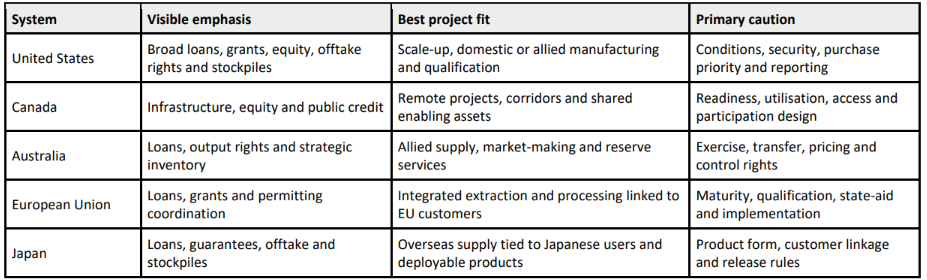
Canada, for example, could also be notably suited to distant tasks requiring corridors and shared infrastructure, whereas European Union applications might higher match built-in mining and processing tasks supplying EU clients. Japan’s system is geared towards abroad provide linked to Japanese customers, whereas Australia’s strategy fits tasks that may present allied provide and strategic reserve providers.
Governments ought to attempt to handle the capital they’re planning to put money into the sector as a portfolio and make help staged and conditional, GEM says.
These fashions will be replicated in different nations, so long as an analogous framework is used, aiming to transform a reputable mission into certified and dependable provide.
The research’s last take a look at is whether or not authorities involvement produces growth that wouldn’t in any other case happen. With out that additionality, public financing dangers merely changing non-public capital or granting governments strategic rights over tasks that might have proceeded anyway.