Ethereum builders are weighing a brand new protection towards predatory buying and selling bots that exploit pending transactions earlier than they attain the blockchain.
The issue stems from Ethereum’s public mempool, a clear ready room the place transactions might be inspected earlier than execution. That visibility lets automated merchants spot worthwhile orders and place their very own transactions round them, extracting worth from customers earlier than a commerce settles.
The follow has grow to be most intently related to sandwich assaults. A bot spots a pending swap, buys the identical asset first to maneuver the worth towards the person, then sells instantly after the sufferer’s commerce executes on the worse value.
Whereas estimates counsel losses from such assaults have declined from earlier peaks, the issue has not disappeared. In April, Ethereum co-founder Vitalik Buterin was himself focused when the infamous Jaredfromsubway.eth bot front-ran and back-ran a small swap from considered one of his addresses.

Builders are actually exploring whether or not encryption can take away the informational benefit that makes these assaults doable.
Protocol researchers are scheduled to debate the problem throughout an Aug. 19 “Encrypt the Mempool” name, the place they’ll study proposals designed to hide transaction contents till their place in a block has already been dedicated.
The hassle targets a long-running tradeoff for Ethereum customers. Merchants can already bypass the general public mempool by routing transactions by way of non-public relays, lowering their publicity to front-running. However that safety comes with dependence on intermediaries that management transaction inclusion and availability.
An encrypted public mempool would try to protect permissionless entry to blockspace whereas stopping builders and bots from seeing the underlying commerce earlier than its ordering is fastened.
One main proposal is EIP-8184, generally known as LUCID. The draft would require block builders to decide to sealed transactions containing a rechargeable ticket and encrypted payload with out realizing what the transaction does. Solely after the dedication is made would the sender, or an off-protocol key writer, launch the data wanted to decrypt it.
Whereas that design closes one avenue for exploitation, it additionally creates one other downside Ethereum builders have but to unravel.
The decryption dilemma
A completely enshrined encryption scheme would want to fulfill a troublesome set of constraints at Ethereum’s scale.
EIP-8184’s authors checklist small public keys, non-interactive decryption, no trusted setup, sensible ciphertext sizes, sturdy chosen-ciphertext safety and a reputable path to quantum security among the many necessities.
They are saying no recognized cryptographic building at present satisfies your entire set at Ethereum’s scale.
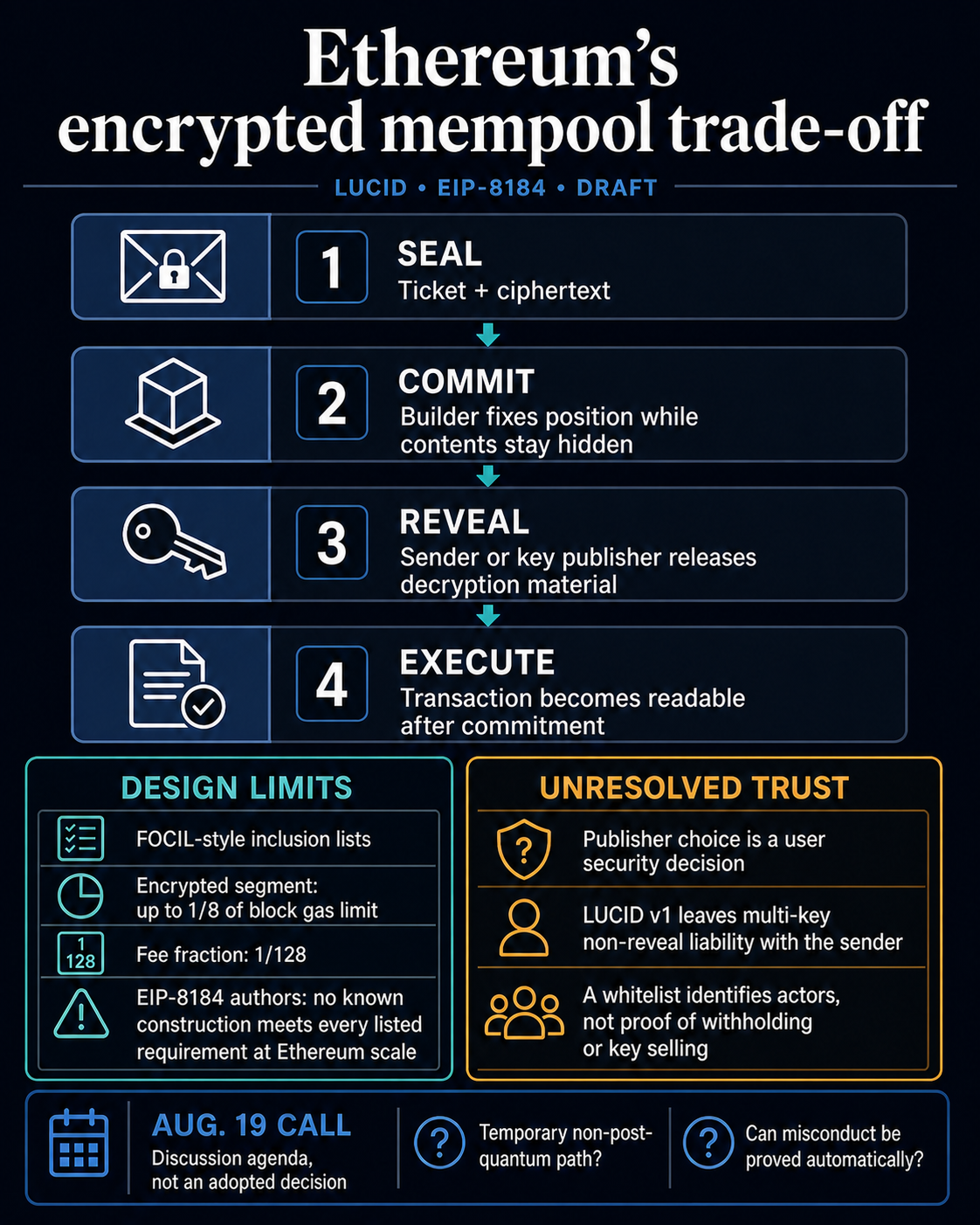
LUCID due to this fact leaves the decryption building exterior the core protocol, permitting senders to handle their very own key launch or comply with directions from a key writer. That preserves flexibility for stronger cryptography later, however EIP-8184’s safety issues explicitly make writer choice a part of the person’s safety mannequin.
The design additionally creates monetary liabilities.
If a key’s withheld or fails to reach on schedule, LUCID’s preliminary draft leaves the protocol-level penalty for a failed multi-key reveal with the transaction sender slightly than mechanically transferring it to the third-party key supplier.
To place an financial value on failed reveals, LUCID caps its encrypted top-of-block phase at one-eighth of the block fuel restrict and makes use of a reservation charge. Most of that quantity might be returned after profitable decryption, whereas the total reservation might be misplaced when the reveal fails.
That makes failed or selective releases costly, however it can not set up why a key didn’t arrive or decide whether or not a writer intentionally leaked it early.
The authors have described an off-protocol sponsorship association the place a writer funds a transaction contained in the bundle and absorbs the loss if it stays sealed. Ethereum itself wouldn’t implement that pledge.
Buying and selling intermediaries and community scaling
Wednesday’s agenda will ask builders whether or not a brief, non-post-quantum cryptographic resolution is suitable.
It additionally targets the deeper enforcement downside: how withholding or early key promoting by members of a validator whitelist may very well be proved and whether or not these proofs may very well be automated.
A whitelist can set up who is permitted to publish keys. It can not by itself distinguish deliberate misconduct from software program failure, community latency, or a missed deadline.
An alternate proposal, EIP-8105, makes use of a directed belief graph the place registered suppliers establish different suppliers they belief. Suppliers can set up their very own withholding situations, leaving incentives, reliability programs, and potential punishment mechanisms exterior Ethereum’s consensus guidelines.
Different approaches introduce their very own prices. Threshold decryption distributes management amongst a number of contributors however provides timing strain. Trusted {hardware} can shorten the trail to a key whereas introducing new {hardware} and operator dependencies.
Any manufacturing deployment would additionally have to coordinate with Ethereum’s broader roadmap. LUCID is designed to increase the inclusion-list pipeline related to FOCIL, or EIP-7805, which provides a number of validators a job in figuring out transactions a builder should embody.
Ethereum’s safety roadmap at present targets FOCIL as a consensus-layer precedence for the Hegotá improve in 2027, whereas broader post-quantum infrastructure milestones sit additional out.