Sandwich assaults price Ethereum customers an estimated $60 million per yr. Transactions broadcast to the general public mempool are publicly seen earlier than inclusion, which provides MEV bots the power to have an effect on the order of transactions and insert their very own for revenue. This drawback has persevered on some degree regardless of years of dialogue and varied out-of-protocol mitigation makes an attempt.
Encrypting mempool transactions can be some of the compelling options to forestall MEV. Whereas this concept has been actively mentioned for years, it has not but been carried out on the protocol degree. In our earlier analysis, we examined a number of proposals based mostly on threshold-encryption, together with Shutter, Batched Threshold Encryption, and Flash Freezing Flash Boys. On this article, we flip to a meta proposal titled “Common Enshrined Encrypted Mempool (EIP-8105)“.
How EIP-8105 approaches mempool encryption
Common Enshrined Encrypted Mempool, also referred to as EIP-8105, is a scheme-agnostic encrypted mempool design, which suggests it could possibly assist a variety of encryption strategies, together with threshold encryption, MPC committees, TEEs, delay encryption, and absolutely homomorphic encryption. A brand new system contract on the execution layer, known as the important thing supplier registry, is deliberate to facilitate this versatile design. It might enable any account to register as a key supplier that holds and divulges decryption keys utilizing their very own most popular encryption expertise.
How transactions are executed in Common Enshrined Encrypted Mempool
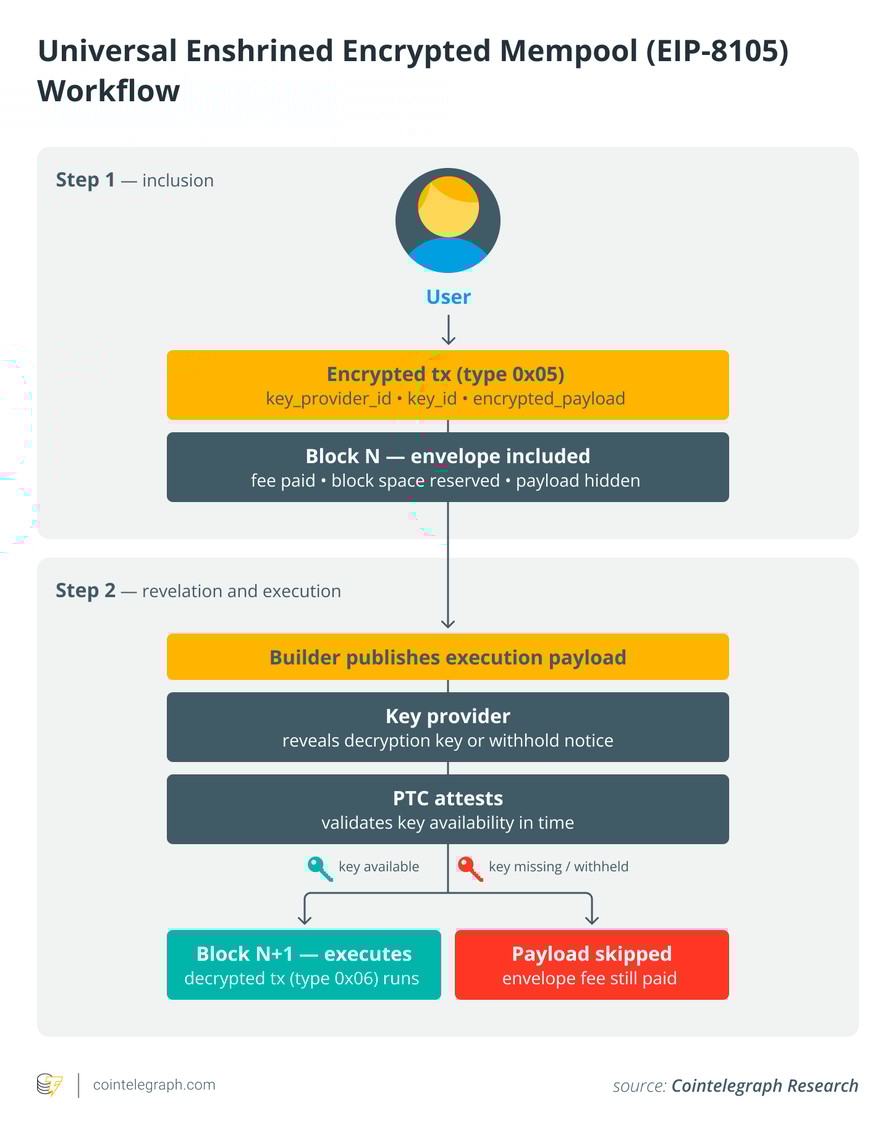
Common Enshrined Encrypted Mempool introduces two new transaction varieties underneath the EIP-2718 framework: 0x05 for encrypted transactions and 0x06 for decrypted transactions. An encrypted transaction is an envelope with an encrypted payload and a public payload, which comprises the envelope nonce, fuel quantity, fuel value parameters, key supplier ID, key ID, and a signature. This construction is required to affiliate the transaction with the chosen key supplier, assign a nonce and guarantee fuel charges for the blockspace are lined.
EIP-8105 follows a two-step execution move. In step one, the encrypted transaction envelope is included in a block though the payload itself stays hidden. Key suppliers monitor transactions with encrypted payloads, acquire the related transaction key IDs, and publish both the corresponding decryption keys or a withhold discover as soon as the block builder publishes the information.
As soon as the block builder has revealed the execution payload, the related key supplier reveals both the decryption key or a withhold discover. A Payload Timeliness Committee (PTC) screens whether or not the decryption keys referenced by encrypted transactions are revealed on time, validates them, and attests as to whether a legitimate key was current or lacking. If the secret is obtainable and decryption succeeds, the ensuing decrypted transaction is executed within the following block. If the secret is lacking, withheld, or decryption fails, the decrypted payload is skipped, whereas the envelope stays included, and the transaction price remains to be paid.
The EIP additionally enforces a block construction that forestalls MEV-extracting transactions from being inserted within the window between decryption and execution. Decrypted transactions should seem initially of a block, plaintext transactions stay within the center, and encrypted transactions are positioned on the finish. This ordering permits encrypted payloads to be revealed and executed solely after inclusion, whereas stopping secondary MEV.
Whereas EIP-8105 considerably limits MEV publicity, earlier suppliers within the block retain a restricted skill to extract MEV from later transactions by selectively revealing or withholding their decryption keys. The proposal makes an attempt to mitigate this by letting key suppliers designate different trusted suppliers and ordering transactions in keeping with the ensuing key supplier belief graph.
Encrypted Mempools and Ethereum’s Roadmap
Encrypted mempools have gotten an more and more vital a part of Ethereum’s roadmap, because the ecosystem appears to be like for protocol-level methods to scale back dangerous MEV. Whereas EIP-8105 is now not being positioned as one of many headliners for the primary 2027 laborious fork, it stays an open draft, and its concepts proceed to tell the broader effort to arrange a number one encrypted-mempool proposal for the improve.
This text is for basic informational functions solely and doesn’t represent authorized, tax, monetary, funding, or different recommendation. The views expressed are the writer’s personal and don’t essentially replicate these of Cointelegraph, which doesn’t endorse this content material or any merchandise talked about herein. All investments carry threat — readers ought to conduct their very own analysis and bear full duty for his or her choices. Cointelegraph strives for accuracy however makes no ensures relating to the completeness or reliability of the data offered, together with any forward-looking statements, and accepts no legal responsibility for any loss or harm arising from reliance on this content material.