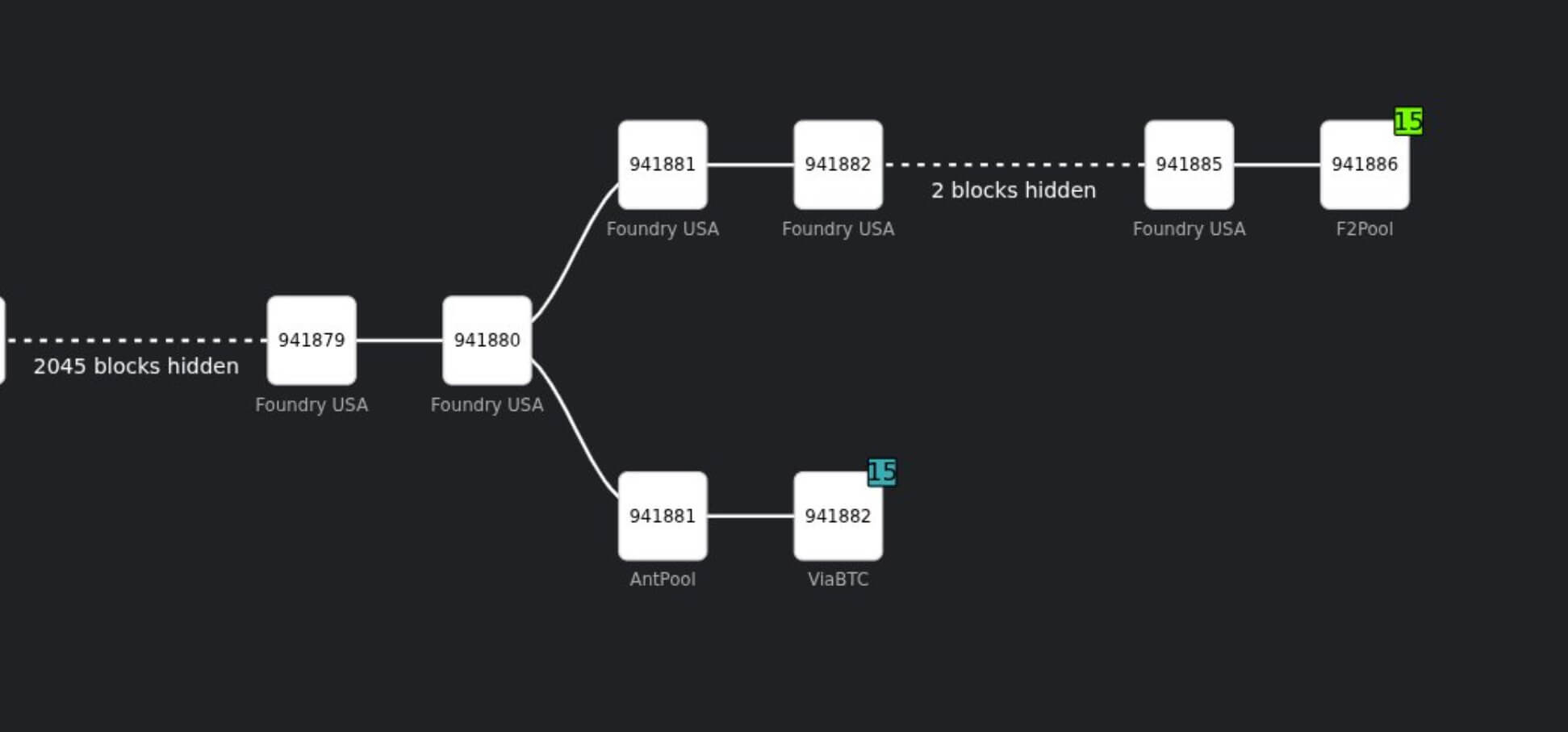
The Bitcoin community skilled a uncommon two-block reorg on Mar. 23, at block peak 941,880. Foundry mined six consecutive blocks, AntPool and ViaBTC briefly prolonged a competing department.
The chain resolved the fork as designed, following the trail with probably the most hash fee. Bitcoin carried out precisely as designed and validated its assumptions.
The heuristic no person labeled
The six-confirmation rule is among the items of acquired knowledge which have traveled so removed from their origins that most individuals who repeat it might probably’t reconstruct why six is the quantity.
The reply traces again to Satoshi Nakamoto’s 2008 whitepaper, which modeled finality as a catch-up likelihood. As sufficient blocks pile up on high of a transaction, the computational value of rewriting historical past turns into prohibitive for an attacker with restricted hashpower.
Six blocks turned the group shorthand for “protected sufficient,” regardless that the whitepaper handled it as a calculation that assumes the attacker controls about 10% of the community’s hashpower.
That assumption has been quietly doing a number of work for sixteen years.
Jameson Lopp made the implication specific in an evaluation of affirmation threat. The consolation degree baked into six confirmations is a perform of who else is on the community and the way a lot of it they run.
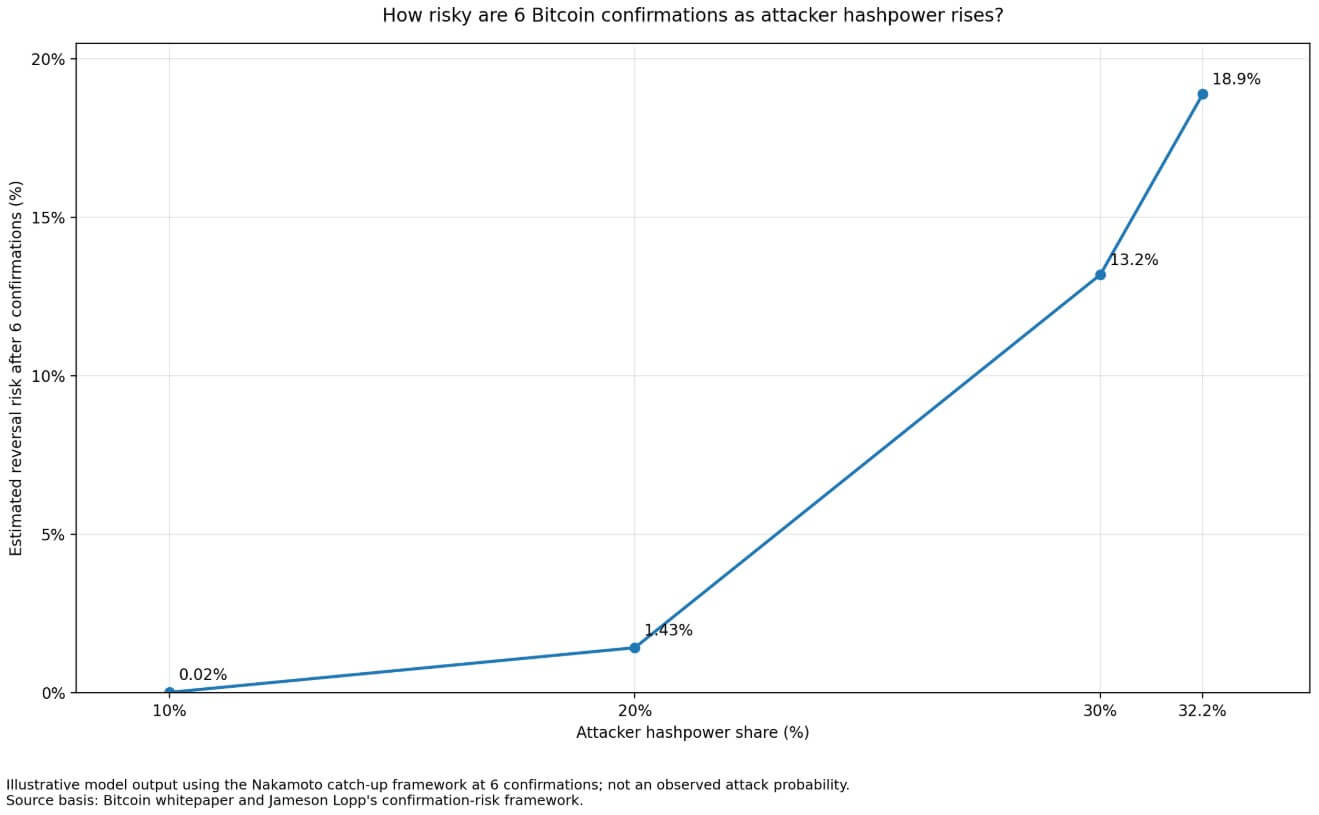
Beneath the Nakamoto catch-up mannequin, six confirmations towards an attacker holding 10% of hashpower yields a reversal threat of roughly 0.02%. Towards 20%, that determine climbs to about 1.43%. Towards 30%, it reaches roughly 13.2%.
On the 32.2% share Foundry held in latest pool-share snapshots, the identical mannequin places six-confirmation reversal threat close to 18.9%.

Mining swimming pools aren’t coordinated attackers by default, which is why they do not slot in these mannequin outputs. Foundry USA describes itself as an institutional-grade pool constructed for miners that coordinates many impartial operators.
Miners can and do change swimming pools, making an overt assault can be economically self-destructive for any rational pool operator. Focus in block manufacturing modifications the danger mannequin folks use to determine when a cost feels closing, no matter how dispersed the underlying machines are.
A 2022 latency safety evaluation famous that with a ten% adversary and a 10-second propagation delay, six confirmations nonetheless produce a safety-violation likelihood between 0.11% and 0.35%.
Six was by no means a tough ceiling, even underneath situations way more favorable than these of right now.
Three situations without delay
The context surrounding the reorg carries the burden.
Bitcoin’s community is at the moment working three situations concurrently that put the six-confirmation heuristic underneath stress, which it has not often confronted in observe.
Prior to now three days, Foundry has held roughly 31% of the worldwide hashrate, whereas AntPool sits at about 18.4%, and ViaBTC at 10.5%, based on Hashrate Index knowledge. These three swimming pools mixed account for about 60% of block manufacturing.
That diploma of focus in coordinator energy is elevated by any cheap measure over the past a number of years.

On the similar time, mining economics have deteriorated sharply. Issue dropped 7.76% on Mar. 21 in one in all 2026’s largest damaging changes. Hashprice averaged $32.31 per petahash per day in February, down almost 18% month over month, briefly touching a file low of $27.89.
Transaction charges contributed simply 0.57% of complete block rewards within the final 24 hours of obtainable knowledge.
When margins compress and payment income dries up, smaller and mid-sized miners face a rising incentive to pool into whichever coordinator provides the most effective variance discount. This often means the already-large swimming pools get bigger.
The January winter storm provided a counterpoint value noting. Foundry’s hashrate reportedly dropped by round 60%, or almost 200 exahashes per second, throughout that interval, demonstrating that pool shares can redistribute shortly when exterior situations change.
Amid this backdrop, the six-confirmation rule lacks an computerized adjustment mechanism when pool shares transfer.
| Situation | Newest studying | Why it issues for the 6-confirmation rule |
|---|---|---|
| Pool focus | Foundry ~31%; AntPool ~18.4%; ViaBTC ~10.5% | A bigger share of block manufacturing is concentrated in a couple of coordinators, making fixed-confirmation assumptions much less comfy for large-value settlement. |
| High-three focus | ~60% of block manufacturing mixed | Finality relies upon not simply on block depend, however on how distributed hashpower is throughout competing swimming pools. |
| Issue adjustment | -7.76% on Mar. 21 | A big damaging adjustment indicators stress in mining situations and weaker economics throughout the community. |
| February hashprice | $32.31 per PH/day | Decrease miner income will increase the inducement for smaller miners to hunt stability in bigger swimming pools. |
| Intramonth hashprice low | $27.89 | The deeper margins compress, the extra pooling for variance discount turns into enticing. |
| Payment contribution to rewards | 0.57% within the final 24 hours | Weak payment help leaves miners extra depending on shrinking block-subsidy economics. |
| Counterpoint: redistribution threat | Foundry reportedly fell ~60% through the January winter storm | Focus is elevated, however not fastened; exterior shocks can nonetheless reshuffle pool shares shortly. |
In observe, the trade’s largest venues have deserted the six-confirmation customary in a quiet operational judgment made years in the past.
Coinbase requires two confirmations for BTC deposits to be marked as pending, whereas Kraken and Gemini every require three.
None of these thresholds is incorrect for his or her use circumstances: for strange retail deposits, two or three confirmations signify a wholly defensible threat tolerance.
The hole between these real-world numbers and the people customary of six illustrates that “six confirmations” was all the time extra a cultural artifact than a common coverage.
Lopp’s framework argues that this hole ought to develop extra deliberate. Required confirmations ought to scale with transaction worth and the economics of the attacker.
A $500 retail deposit and a $50 million OTC settlement don’t share the identical threat profile, and the trustworthy model of finality steering would explicitly state so.

The quantity that stayed the identical
There are completely different outcomes within the present hashrate focus situation, which raised an alarm for customers.
Positively, hashrate redistributes throughout a broader pool of coordinators as mining margins finally recuperate and new entrants compete for share.
The January storm already demonstrated that Foundry’s dominance can erode shortly underneath the fitting situations. If focus eases and the hash worth recovers, six confirmations stay an inexpensive default for giant BTC settlements.
On the flip facet, Foundry may stay above 30%, and the top-three focus stays sticky. No malicious occasion is required for the norm to degrade, as exchanges, OTC desks, and retailers dealing with high-value transfers can quietly elevate inside thresholds or formalize dynamic tiers tied to observable pool-share knowledge.
Beneath the Nakamoto mannequin, six confirmations towards a totally coordinated 32.2% attacker leaves roughly 18.9% catch-up threat, a determine genuinely troublesome to reconcile with language like “successfully irreversible” for transfers within the tens of tens of millions of {dollars}.
The scenario requires solely that the pool focus stay the place it’s, whereas the hole between the people customary and the precise threat widens sufficient that somebody with cash on the road stops ignoring it.
Bitcoin’s settlement assurances had been all the time “six blocks, underneath a sure distribution of hashpower and a sure tolerance for threat.”
The 2-block reorg produced a uncommon second when the hole between Bitcoin’s finality folklore and its underlying math turned exhausting to disregard.
Contemplating this second, the six-confirmation rule’s days as a common, unqualified customary are working out.